Galaxy Basics
Galaxies consist of stars, planets, and vast clouds of gas and dust,
all bound together by gravity. The largest contain trillions
of stars and can be more than a million light-years across.
The smallest can contain a few thousand stars and span just
a few hundred light-years. Most large galaxies have supermassive black holes at their centers,
some with billions of times the Sun’s mass.
Galaxies come in a variety of shapes, mostly spirals and ellipticals,
as well as those with less orderly appearances, usually dubbed irregular.
Most galaxies are between 10 billion and 13.6 billion years old.
Some are almost as old as the universe itself, which formed around 13.8 billion years ago.
Astronomers think the youngest known galaxy formed approximately 500 million years ago.
Galaxies can organize into groups of about 100 or fewer members held together by their
mutual gravity. Larger structures, called clusters, may contain thousands of galaxies.
Groups and clusters can be arranged in superclusters, which are not gravitationally bound.
Superclusters, empty voids, “walls” of galaxies, and other large-scale structures make up
the cosmic web of matter in the universe.
Our Milky Way
Our home galaxy is called the Milky Way. It’s a spiral galaxy with a disk of stars spanning more
than 100,000 light-years. Earth is located along one of the galaxy’s spiral arms, about halfway
from the center.
Our solar system takes about 240 million years to orbit the Milky Way just once.
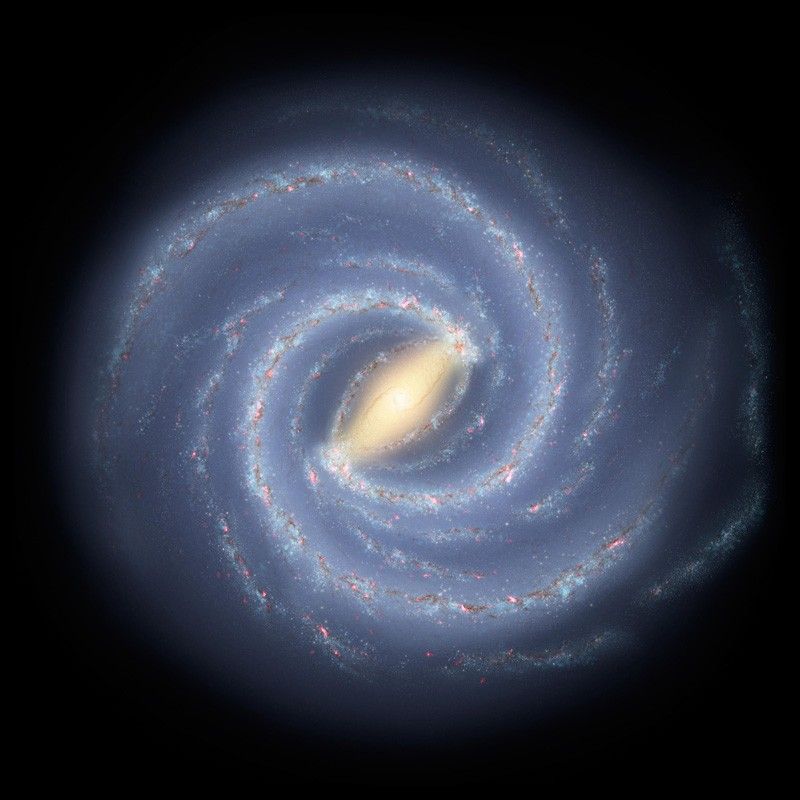
From our perspective on Earth, the Milky Way looks like a faint, milky band of light arcing across
the entire sky, which is how it got its name. This feature marks the central disk of our home galaxy
seen edge on.
The Milky Way sits in a neighborhood with over 50 other galaxies called the Local Group.
Its members range in size from dwarf galaxies (smaller galaxies with up to a few billion stars) to Andromeda,
our nearest large galactic neighbor.
The Local Group sits just off the edge of the Virgo cluster and is part of the Laniakea supercluster.
Andromeda Galaxy
The Andromeda Galaxy, also known as M31 or NGC 224, is a barred spiral
galaxy and the closest major galaxy to our Milky Way.
It's located in the constellation Andromeda and is visible to
the unaided eye from dark locations.
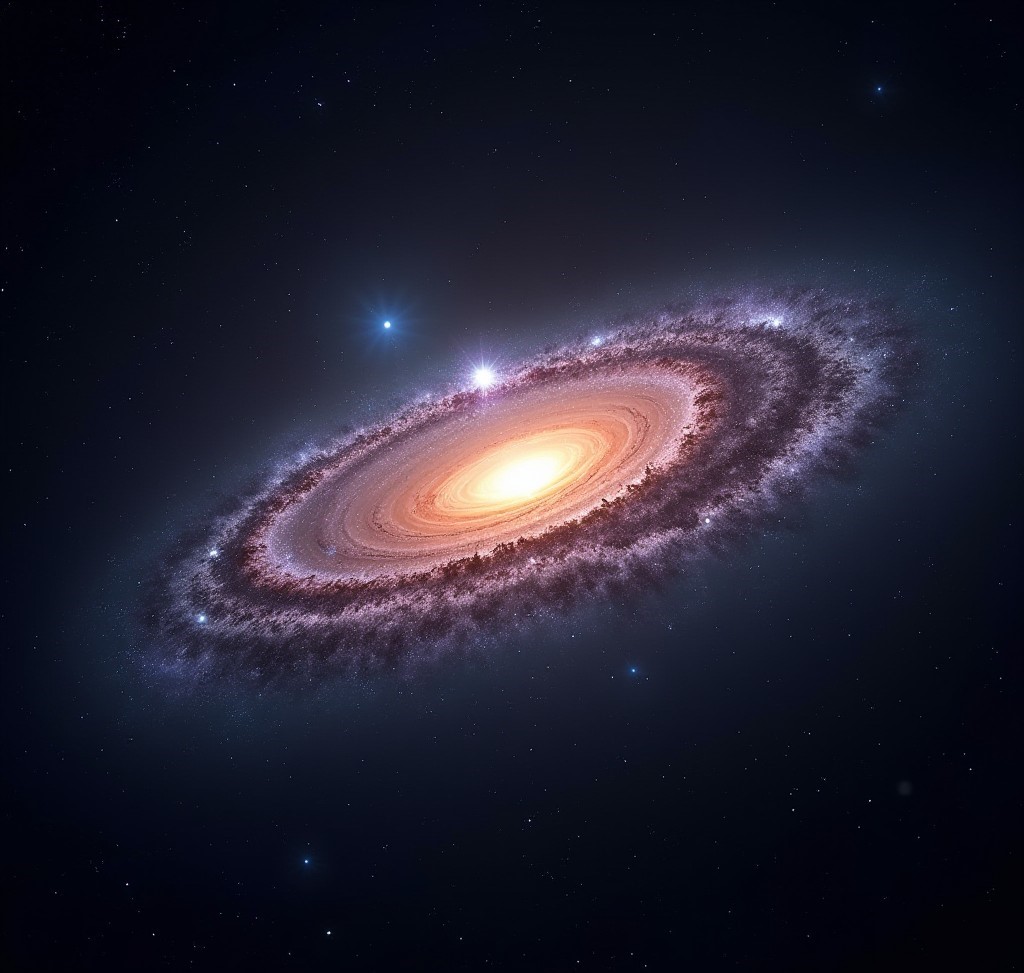
Here's a more detailed look at the Andromeda Galaxy:
Distance: It's approximately 2.5 million light-years away from Earth.
Size: Andromeda is a large galaxy, comparable in size to the Milky Way.
Its diameter is about 200,000 light-years.
Visibility: It's one of the few galaxies that can be seen with the naked eye,
appearing as a faint, milky blur.
Future Collision: Andromeda is on a collision course with the Milky Way,
with the merger predicted to occur in about 4.5 billion years.
Structure: Andromeda is a barred spiral galaxy,
meaning it has a central bar-shaped structure of stars with spiral arms extending outward.
Satellite Galaxies: Andromeda has several
satellite galaxies, including M32 and M110.
Historical Significance: It was first recorded as
a "small cloud" by the Persian astronomer
Al Sufi in 964 AD. Simon Marius observed it with a
telescope in 1612, and Charles Messier cataloged it as M31 in 1764.
Edwin Hubble proved in the 1920s that Andromeda was
a galaxy outside of the Milky Way.
[ Nearest view of Andromeda Galaxy ]
Hubble Studies Small but Mighty Galaxy
This portrait from the NASA/ESA Hubble Space Telescope puts the nearby
galaxy NGC 4449 in the spotlight. The galaxy is situated just 12.5 million light-years away
in the constellation Canes Venatici (the Hunting Dogs). It is a member of the M94 galaxy group,
which is near the Local Group of galaxies that the Milky Way is part of.
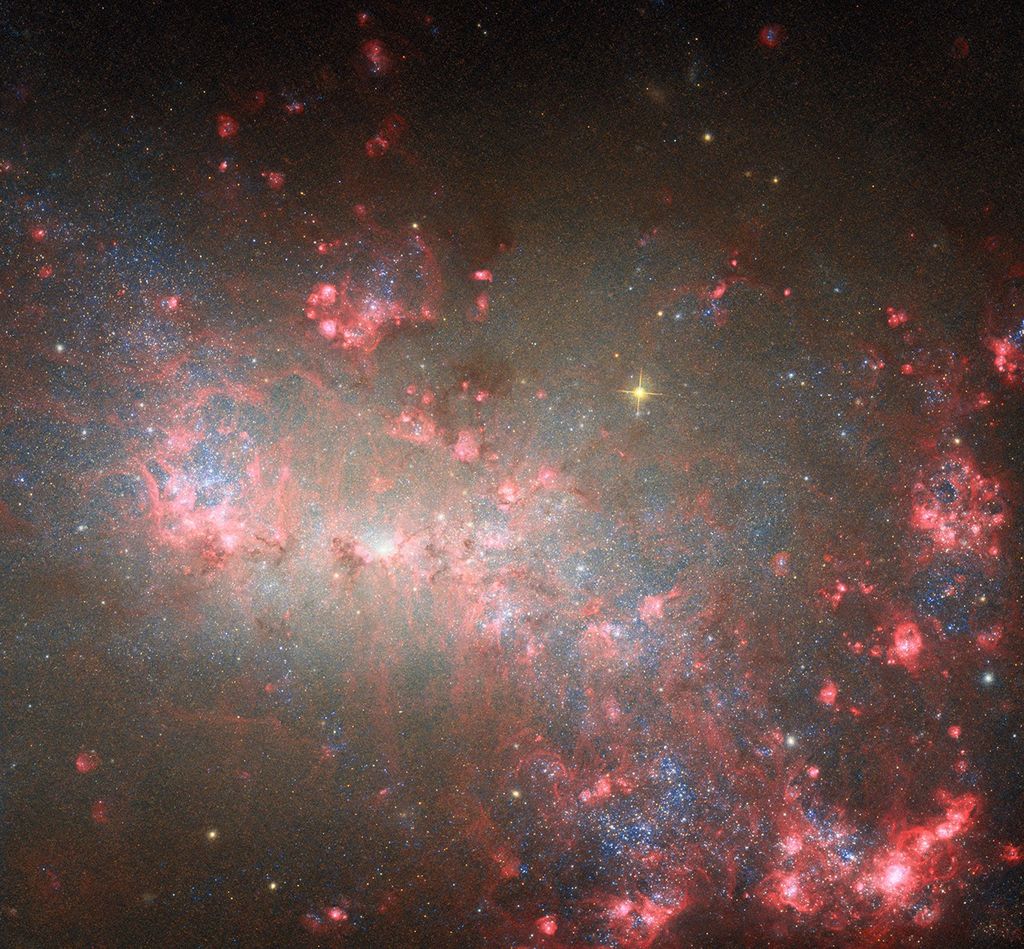
NGC 4449 is a dwarf galaxy, which means that it is far smaller and contains fewer stars than the Milky Way.
But don’t let its small size fool you — NGC 4449 packs a punch when it comes to making stars! This galaxy is
currently forming new stars at a much faster
rate than expected for its size, which makes it a starburst galaxy.
Most starburst galaxies churn out stars mainly in their centers, but NGC 4449 is alight with brilliant young
stars throughout. Researchers believe that this global burst of star formation came about because of NGC 4449’s
interactions with its galactic neighbors. Because NGC 4449 is so close, it provides an excellent opportunity for
Hubble to study how interactions between galaxies can influence the formation of new stars.
Hubble released an image of NGC 4449 in 2007. This new version incorporates several additional wavelengths of light
that Hubble collected for multiple observing programs. These programs encompass an incredible range of science,
from a deep dive into NGC 4449’s star-formation history to the mapping of the brightest, hottest, and most
massive stars in more than two dozen nearby galaxies.
Hubble Studies a Spiral’s Supernova Scene
This serene spiral galaxy hides a cataclysmic past.
The galaxy IC 758,
shown in this NASA/ESA Hubble Space Telescope image,
is situated 60 million light-years away in the constellation Ursa Major.
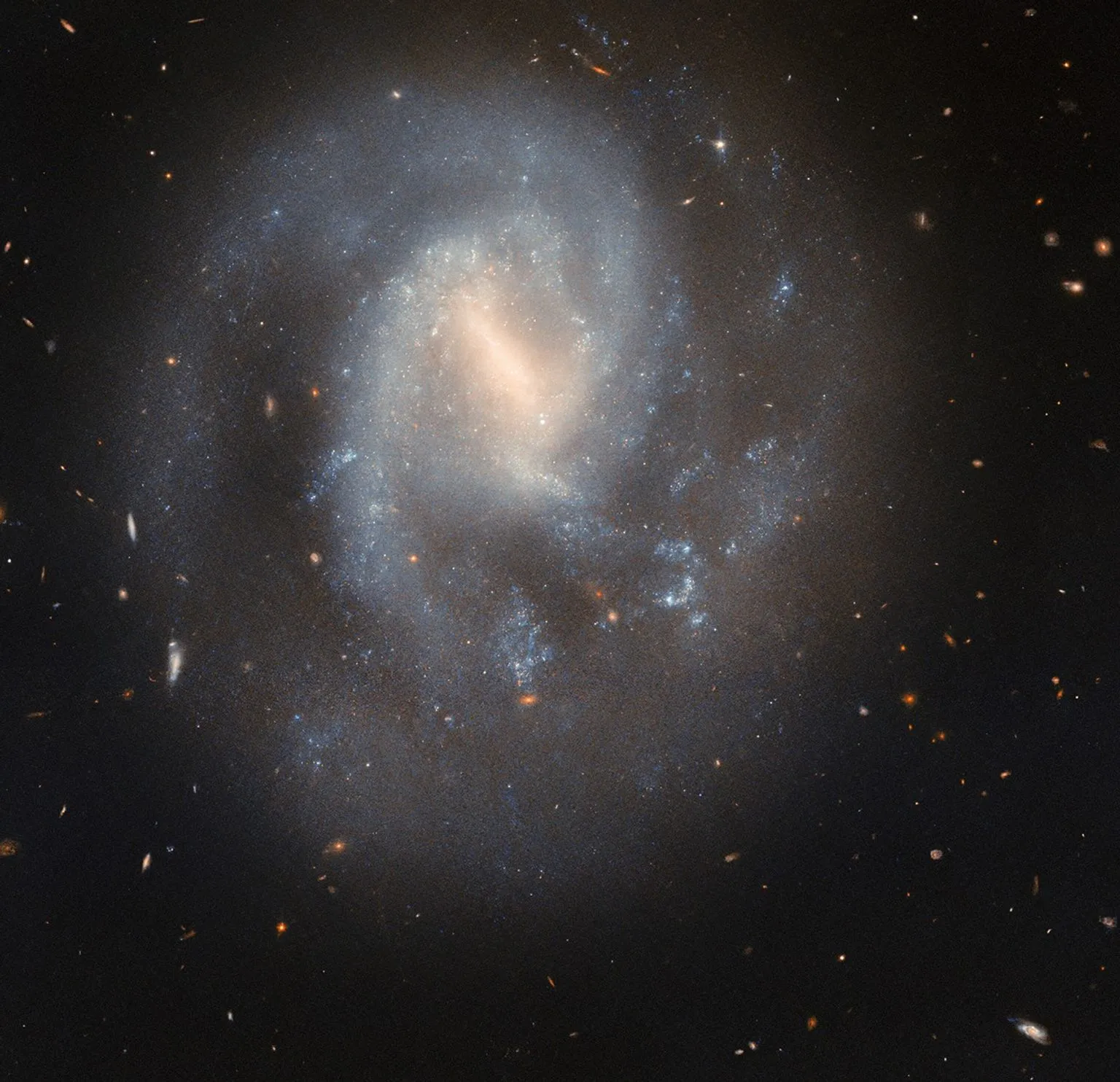
Hubble captured this image in 2023. IC 758 appears peaceful, with its soft blue spiral
arms curving gently around its hazy barred center. However, in 1999, astronomers spotted a powerful
explosion in this galaxy. The supernova SN 1999bg marked the dramatic end of a star far
more massive than the Sun.
Researchers do not know exactly how massive this star was before it exploded,
but will use these Hubble observations to measure the masses of stars in SN 1999bg’s neighborhood.
These measurements will help them estimate the mass of the star that went supernova. The Hubble data
may also reveal whether SN 1999bg’s
progenitor star had a companion, which would provide additional clues about the star’s life and death.
A supernova represents more than just the demise of a single star — it’s also a powerful force that
can shape its neighborhood. When a massive star collapses, triggering a supernova, its outer layers
rebound off its shrunken core. The explosion stirs the interstellar soup of gas and dust out of which new
stars form. This interstellar shakeup can scatter and heat nearby gas clouds, preventing new stars from forming,
or it can compress them, creating a burst of new star formation. The cast-off layers enrich the interstellar
medium, from which new stars form, with heavy elements manufactured in the core of the supernova.